
The cost of becoming British
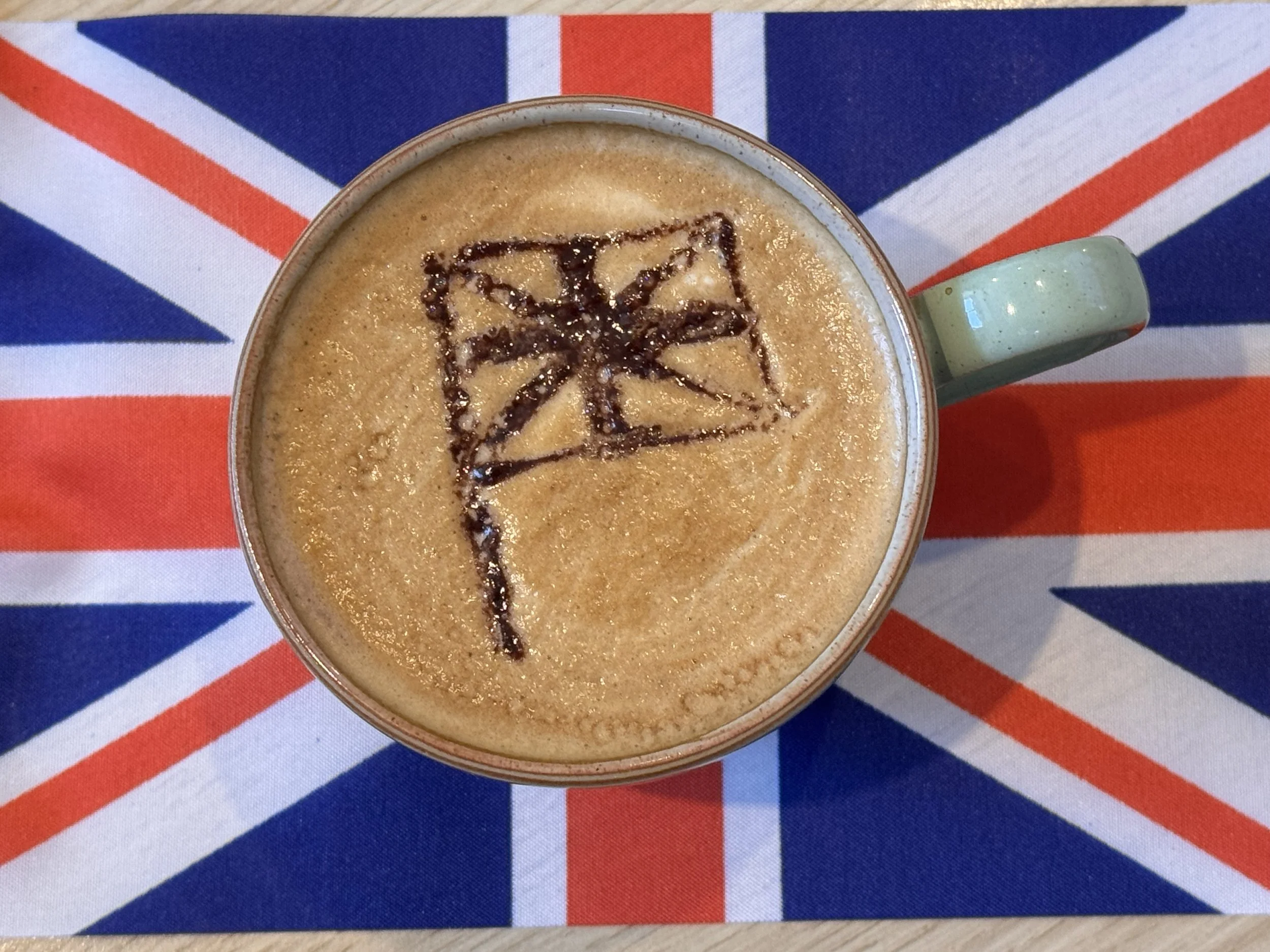
A very special flat white made for me by a coworker the day after I became a citizen.
Dozens of people from around the world sit in tense quiet in a waiting room. Even the children are hushed, as if they can sense the apprehension from their parents. We sit up straight, like model citizens, prepared to follow instructions to the letter, very aware that our way of life hinges on the next hour.
It should be fine.
I tell myself that over and over. The paperwork has gone through, the fees are paid. This is just a formality. Still, I sit with rigid attention, watchful without looking anyone in the eye. I am so close, and I can not afford to make a mistake now.
The Citizenship Ceremony was not optional. And it was not free. Only £130, so very inexpensive relative to the other fees, but I feel a twinge of resentment nonetheless.
My husband immigrated to Canada back in 2006, a straightforward process that cost a grand total of CA$2,200 (roughly £1,100 at 2006 rates). Naively, when we moved to Scotland, I expected the process to be similar.
It was not.
Here is a breakdown of my expenses from when I first applied in 2018 until my citizenship ceremony in 2026.
Initial Spouse Visa (2018)
Visa application fee - £1,523.00
Immigration Health Surcharge (IHS) - £600.00
Biometrics (VAC) - £19.20
Priority processing - £500.00
Immigration lawyer - £1,000.00
Return flights to Canada (CA$1805) - £1,038.00
SUBTOTAL - £4,621.20
Visa Extension 2021
Extension fee - £1,048.00
Immigration Health Surcharge (IHS) - £1,560.00
SUBTOTAL - £2,608.00
Indefinite Leave To Remain Visa (2024)
ILR application fee - £2,885.00
Life in the UK test - £50.00 (fortunately I passed the first time!)
Official 3-book study bundle - £26.59
SUBTOTAL - £2,961.59
Citizenship (2025-26)
Naturalisation application fee - £1,735.00
Citizenship ceremony fee - £130.00
SUBTOTAL - £1,865.00
GRAND TOTAL £12,114.20
(And since the rates have gone up, this would cost closer to £17,000)
I knew immigration would involve paperwork and fees. I did not know the fees would add up to a year’s wages. I did not know I would have to fly to Canada to apply, and then wait three to six months for a decision, or that all the documents I gathered in the UK would have to be printed on letter-sized paper, or that I would undergo four rounds of biometrics (fingerprinting and photos) in a scenario reminiscent of being booked at a police station.
I’d experienced several waiting rooms with various groups of other immigrants, tinged with unease, much like this, but with less comfortable seating and less natural light. By now, I’m used to the heaviness in the air as we stew in our anxiety, culturally worlds apart, yet bound by common experiences.
We are one of the few groups of people in the UK who have memorised the precise year the Spanish Armada invaded England (1588) AND know the inventors of radar, television, penicillin and computer science AND know which athlete won 16 Paralympic medals (Baroness Tanni Grey-Thompson). Why, you ask? Because apparently retaining all that information is vital to being British, hence the Life in the UK test - a series of questions which have very little to do with living in the UK (think Hunger Games meets pub quiz).
We all look up in anticipation as a woman in a nice dress and an official-looking ID lanyard instructs us to follow her. In a kindly way, though, not in the usual brusque manner. Still, we are cautious. We follow in an orderly fashion without a sound, surreptitiously checking passports and papers. We’ve spent years making sure we have exactly the correct documents for each stage of the process. Miss any single item, and you need to re-book your appointment and pay another fee, or worse.
In the next room, the woman comes to each of us to check our documents. This is odd for me. I’m used to queuing under the watchful gaze of security guards after passing through metal detectors, surrounded by signs warning that the room is being monitored by CCTV and that staff can not give immigration advice. This lady is quite friendly and seems happy to answer questions.
“Do I have to memorise the vow?” I ask.
I have already asked this question and googled this question, but my brain is on high alert, searching for anything I might have missed - anything that might trip me up.
“No, don’t worry, there is a printout on each table,” she says reassuringly.
The tension eases slightly.
We file into another room, one group at a time. The Vice Lord-Lieutenant of Aberdeenshire and the Provost make speeches, congratulating us and welcoming us to the country. It’s almost as if we’re all on the same side. This is the first time in the process I have not felt like I’m trying to take something away from the British people. It’s the first time I’ve felt welcome, and maybe even a hint of pride.
Yet the tension remains.
We say our oaths, one by one. I have the advantage that English is my first language, yet my nerves jangle as my turn approaches. I stumble over the word ‘successor’, but no one seems to notice, and I exhale with relief as the next row begins their pledge. Then, one by one, we step forward and receive our certificates.
I babble to the Vice Lord-Lieutenant and the Provost, a mixture of nerves and relief. The Vice Lord hands me an envelope. Back in my seat, I pull out the certificate. It is the most expensive and hard-won piece of paper I have ever held in my hands.
And the atmosphere changes. People start talking, postures relax and smiles grace many faces.
Some escape as soon as they have their paper, and my heart breaks for them. I’m keenly aware that I’ve had it easy compared to many people here. I haven’t had the cost and stress of the English test, not to mention I’ve enjoyed the relative ease of completing convoluted paperwork in my native language and script. And I have the privilege of being white.
Still, many newly minted Brits of all levels of melanin mingle while photographs are taken and stay for refreshments. I almost have a cup of tea, just to check if it tastes better now that I am British, but I stick to coffee and a biscuit. In my head, I now call it a biscuit and not a cookie, so perhaps I am turning British.
The next morning, when I arrive at work, my coworkers surprise me, jumping out from behind the counter, waving British flags. They’ve decorated the shop with red, blue and white balloons, bunting, and British flags, and someone has even brought in cupcakes. Once I recover from my shock, a warmth blooms in my chest. The UK immigration process made me feel like a borderline criminal, but the Scottish people have welcomed me with open arms, and now that I’m officially a British citizen, that’s all that matters.